Both the Citi Double Cash and the Wells Fargo Active Cash promise something close to a flat 2% back on everything you buy, with no annual fee and no rotating categories to track. On the surface they look interchangeable. The differences show up in when you earn the rewards, how the cards handle travel, and which extra protections come along for the ride. Here is how the two stack up if you want one card that earns the same rate everywhere.
How Double Cash earn mechanics work
The Citi Double Cash splits its rate into two halves. You earn cash back when you buy something, and you earn the rest when you pay that balance off. That is the "double" in the name: a portion as you spend, and a portion as you pay. Add them together and you land at an effective 2% on most purchases.
The practical takeaway is that the second half is tied to paying your bill, not to carrying a balance. If you pay your statement in full each month, you collect both halves and there is nothing to think about. The mechanic mostly matters as a reminder of why this card rewards people who clear their balance rather than revolve it.
Rewards on the Double Cash accrue as ThankYou-program value, which gives you redemption options beyond a plain statement credit. Exact redemption choices and any minimums change over time, so confirm them on Citi's site before you count on a specific path.
Active Cash — simpler 2% structure
The Wells Fargo Active Cash takes the more straightforward route: you earn unlimited 2% cash rewards on purchases in one step, at the time of the purchase. There is no pay-it-off half to wait for. For people who want the math to be obvious, that single-step structure is the main appeal.
You still want to pay in full, because interest will quickly outweigh a 2% reward if you carry a balance. But the earning itself does not depend on the payment, so the rate is easy to reason about. Redemption is typically as cash back, and Active Cash has historically been paired with cell phone protection when you pay your monthly phone bill with the card, subject to a deductible and the issuer's terms. Treat that benefit as a reason to read the current guide to coverage rather than a guarantee, since insurance terms get revised.
| Feature | Citi Double Cash | Wells Fargo Active Cash |
|---|---|---|
| Base rate | ~2% (1% buy + 1% pay) | 2% unlimited, single step |
| Annual fee | None | None |
| When you earn | Half on purchase, half on payment | All at purchase |
| Rewards type | ThankYou-program value | Cash rewards |
| Cell phone protection | Not a core feature | Available via paying phone bill with the card (terms apply) |
Foreign travel and transaction fees
This is where a flat-2% card can quietly cost you. Both of these cards have generally charged a foreign transaction fee on purchases processed abroad. That fee is usually around 3% of each transaction, which cancels out most of your 2% earning and then some on overseas spending.
If you travel internationally or shop from non-U.S. merchants, neither of these is the card to swipe abroad. You would pair it with a no-FTF card for trips. See our roundup of credit cards with no foreign transaction fee in 2026 for options that fit alongside a flat-rate daily driver. For purely domestic spending, the FTF never comes into play and both cards behave the same on this point.
Because fees and benefit terms get updated, check the current cardmember agreement on the issuer's page before you assume a 3% fee or any specific number.
Sign-up offers — verify on issuer sites
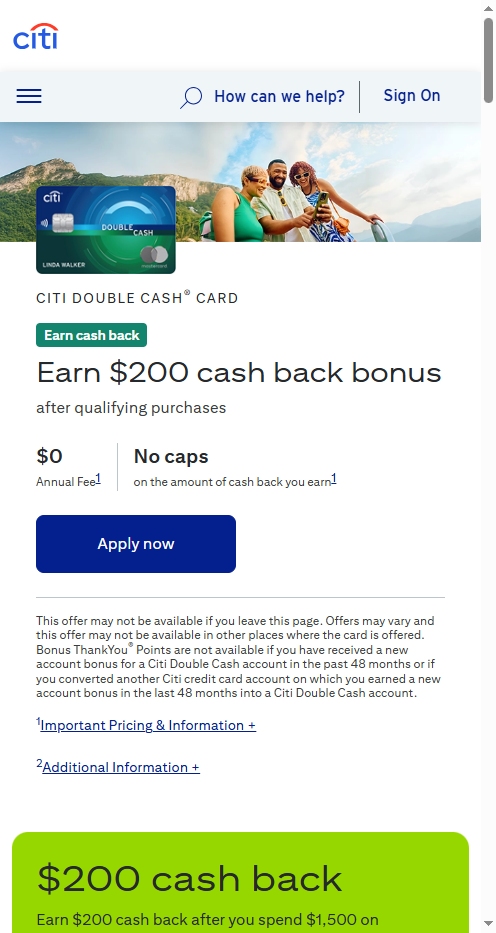
Both cards have run welcome offers in the past, often a cash bonus after meeting a spending requirement in the first few months. The size of those offers, the spending threshold, and whether one exists at all change frequently and can differ by application channel.
Do not pick a card based on a bonus you read about secondhand. Pull up the official application page and read the offer that is live for you on the day you apply. A welcome bonus is a one-time event; the everyday 2% rate is what you live with for years, so weigh the structure and benefits more heavily than a temporary promotion.
If you are building a no-fee setup, it is worth seeing how each of these fits into a broader lineup of no annual fee credit cards rather than judging them in isolation.
Which flat 2% card to pick
For most people the choice comes down to a few honest questions:
- Do you want the simplest possible earning? Active Cash gives you the full 2% in one step, which is easier to track.
- Do you value cell phone protection? Active Cash's phone-bill benefit can offset the cost of a separate plan if you actually use it and read the deductible terms.
- Do you already live in the Citi ThankYou world? If you hold other Citi cards, Double Cash's rewards can combine for more flexible redemptions, which tips the scale toward Citi.
- Do you sometimes carry a balance? Neither card is a balance-carrying tool, but Double Cash's design specifically nudges you to pay in full to collect both halves.
If you are deciding among several Citi products before committing, our look at the best Citi credit card options can help you see where Double Cash sits in that family. Either way, both are reasonable no-fee anchors for domestic, everyday spending, and the right pick is the one whose extras you will actually use.
Common questions
Is the Citi Double Cash really 2% back?
It works out to about 2% on most purchases, earned in two parts: a share when you buy and a share when you pay your bill. Pay in full each month and you collect both halves, which lands you at the effective 2% rate.
Does Wells Fargo Active Cash charge a foreign transaction fee?
It has historically charged a foreign transaction fee, commonly around 3% per purchase abroad. That fee largely erases the 2% reward on overseas spending, so use a no-FTF card for international trips and confirm the current fee on the Wells Fargo page.
Which card has the better welcome bonus?
Offers change often and can vary by where you apply, so neither one is permanently "better." Check the live offer on each issuer's official application page on the day you apply rather than relying on a figure from a third-party article.
Can I have both cards?
Generally yes, subject to each issuer's approval rules. Some people keep one as a primary 2% card and the other as a backup, though for most a single flat-rate card paired with a no-FTF travel card covers nearly everything.
Last updated: June 2026. Rates, fees, and issuer rules change — confirm current terms before you apply or transfer a balance. This is general information, not personal financial advice.
Tired of receiving your unsolicited mail, time for you to cease sending your mail. If I need a credit card I will ask for it on my own time.
hey there.. please call capital one at 1-877-383-4802 and tell them you would like your information removed from their system and no more mailings